Gantral
Execution Authority Infrastructure for Enterprise Agentic AI
When AI-assisted execution affects money, infrastructure, customers, or regulatory exposure, authority cannot be reconstructive.
It must be structural.
Gantral enables organizations to:
Prove who authorized high-impact AI decisions.
Survive adversarial audits without relying on logs.
Scale AI without fragmenting governance.
→ Read the Paper
→ Explore Architecture
→ Verifiability & Independent Replay
→ Git
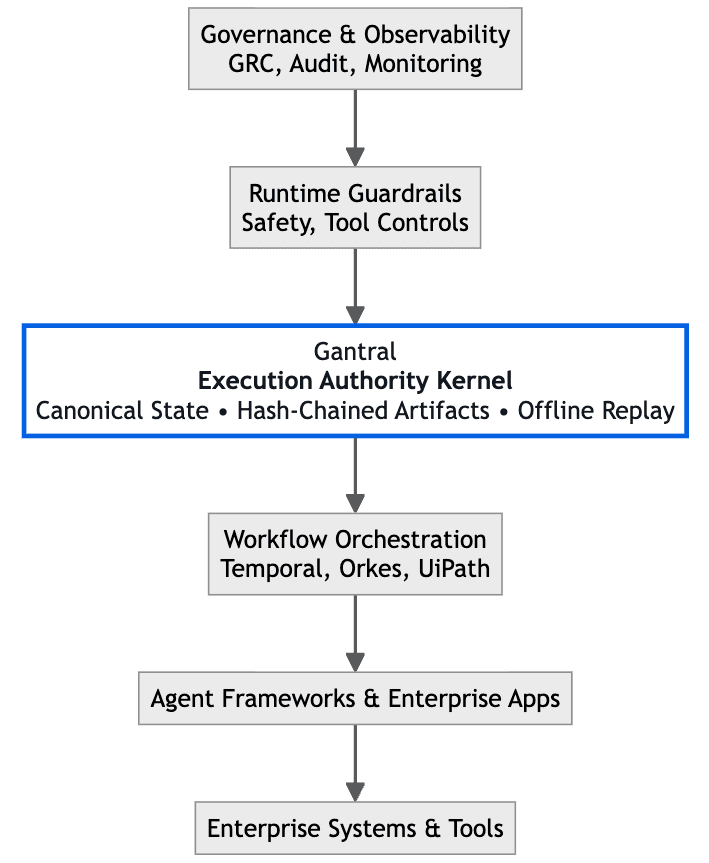
Gantral is the execution authority infrastructure layer for high-consequence AI workflows.
Audit Logs Reconstruct.
Gantral Proves.
AI pilots move fast.
Enterprise deployment slows down.
Not because models fail.
Because execution authority remains implicit.
As AI enters material workflows, three structural failures emerge:
1. Policy Drift
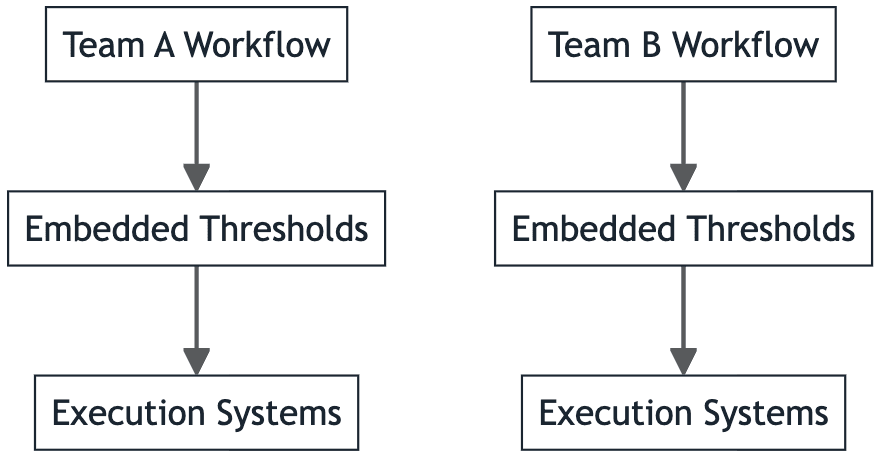
Approval thresholds embedded in workflow code.
Policy changes require redeployment across teams.
Enterprise scenario:
A change in approval threshold requires redeploying 12 workflows across 4 teams — introducing risk, delay, and divergence.
2. Execution Fragmentation
Human approvals are embedded as workflow tasks.
Execution resumes without structural authority binding.
Enterprise scenario:
A high-value financial transfer enters a human approval step inside a BPMN or Temporal workflow.
The approval task is marked “completed,” and the workflow resumes execution.
The approval record exists in the workflow database, but the execution state transition and the authority decision are not atomically bound.
The workflow version, policy version, and approval context are not cryptographically linked.
During audit, the organization can show the task was completed, but cannot independently prove that authority and execution were inseparable at the moment of transition.
3. Broken Chain of Custody
When actions are challenged, authority must be reconstructed.
Enterprise scenario:
During audit, teams reconstruct approval history from logs, tickets, and emails.
Reconstruction is not proof.
Audit logs reconstruct.
Gantral proves.
What Gantral is
Gantral is an Execution Authority Infrastructure for Agentic AI.
It introduces deterministic authority semantics directly into workflow state.
Modern enterprise AI stacks include:
Agent & Tool Layer
Workflow Orchestration
Runtime Guardrails
Observability & GRC
These systems are powerful.
But none structurally govern authority.
Layer
What It Does
Orchestration
Coordinates tasks
Guardrails
Filter actions
Observability
Reports behavior
Gantral
Makes authority part of execution state
Gantral does not replace orchestration, guardrails, or GRC.
It makes authority a property of execution.
Gantral Is Not Required for Every Workflow
This is intentional.
When Orchestration Alone Is Enough
Gantral is likely unnecessary for:
Internal HR approvals
Low-value vendor invoices
Marketing budget requests
Low-impact automation workflows
Modern orchestration platforms are sufficient.
When Structural Authority Is Justified
Structural authority binding becomes rational infrastructure when:
Financial exposure exceeds material thresholds
Regulatory enforcement is plausible
Litigation risk exists
Board-level explanation may be required
Decisions could be challenged years later
If this decision appeared in front-page litigation two years from now,
could you independently prove that authority was exercised correctly?
If that answer depends on logs and reconstruction,
structural authority may be warranted.
Designed for High-Consequence Workflows
Gantral is built for workflows where:
Financial Services
Large funds transfer release
AI underwriting override
AML alert clearance
Trading kill-switch override
Healthcare
AI treatment override
High-risk drug authorization
Clinical eligibility approval
Enterprise IT & Security
AI-assisted production deployment
Break-glass privileged access
Security rule override
Government
Benefits eligibility override
Procurement approval
Permit issuance override
If your workflow moves regulated money, escalates privileged access, alters critical infrastructure, or creates legal exposure, authority must be structural.
Orchestration ensures correct execution.
Gantral ensures defensible execution.
Do You Need Structural Authority?
Before introducing structural authority, assess your workflow:
Would this decision survive adversarial audit using only logs?
Could this decision appear in litigation?
Is a human legally accountable?
Are policy thresholds updated over time?
Does approval occur in a separate system from execution?
If 3 or more answers are “Yes,” structural authority binding may be justified.
The Shift
Approvals and audit logs have existed for years.
But AI systems have changed.
They now:
Make dynamic decisions
Trigger real-world actions
Operate across systems
Affect money, infrastructure, and customers
When impact increases, reconstruction is no longer enough.
You must prove that authority was valid at the moment execution resumed.
Approval can no longer be just a task.
It must be an enforced boundary.
Authority must be:
Explicit
Validated
Recorded in a way that cannot be altered
Example: Large Funds Transfer Release
AI flags a high-risk transaction.
A human approves override.
Funds are released.
Without Structural Authority
Approval recorded as workflow task
Logs reconstruct history
With Gantral
Execution cannot proceed without binding authority
Policy version is fixed
Artifact chain proves integrity
Replay is independent of runtime
Audit logs reconstruct.
Gantral proves.
Separation of Policy and Code
Gantral integrates with policy engines (e.g., OPA) in advisory mode.
Policy bundles are versioned.
Policy thresholds are external to agent code.
Workflow implementations remain deterministic.
Policy updates do not require agent redeployment.
This reduces:
Agent workflow duplication
Configuration drift
Governance fragility
Operational risk
Before
With Gantral
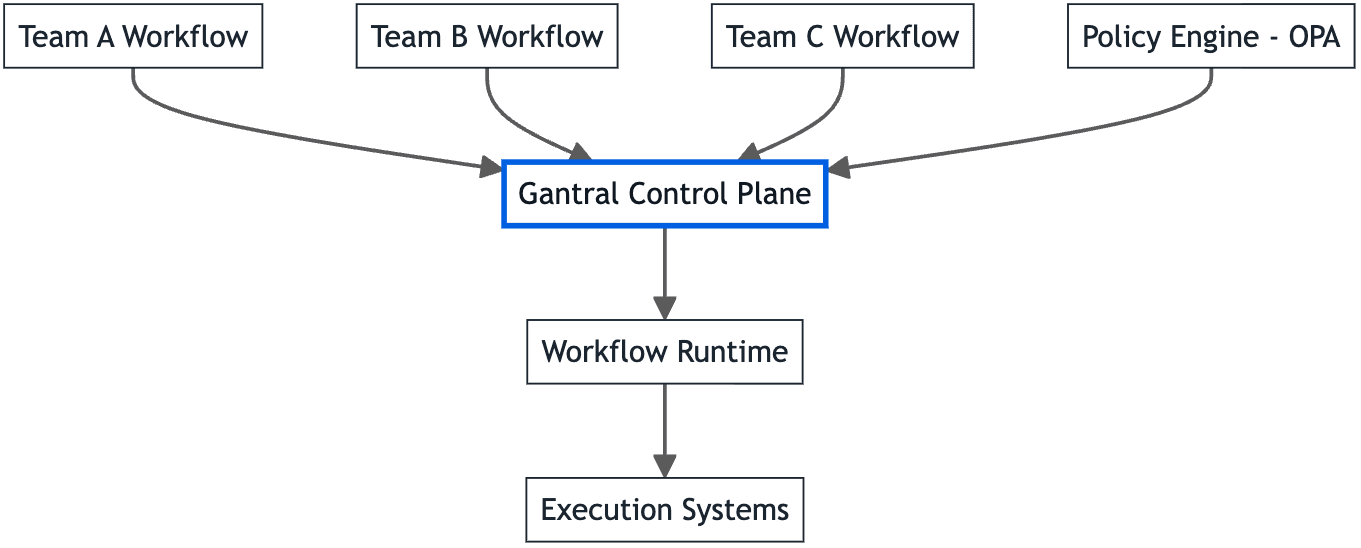
Policy updates no longer require workflow redeployment.
Where Gantral Sits
Gantral Sits:
Below guardrails
Above orchestration
Between agent frameworks and workflow runtimes
It alone advances or blocks execution state.
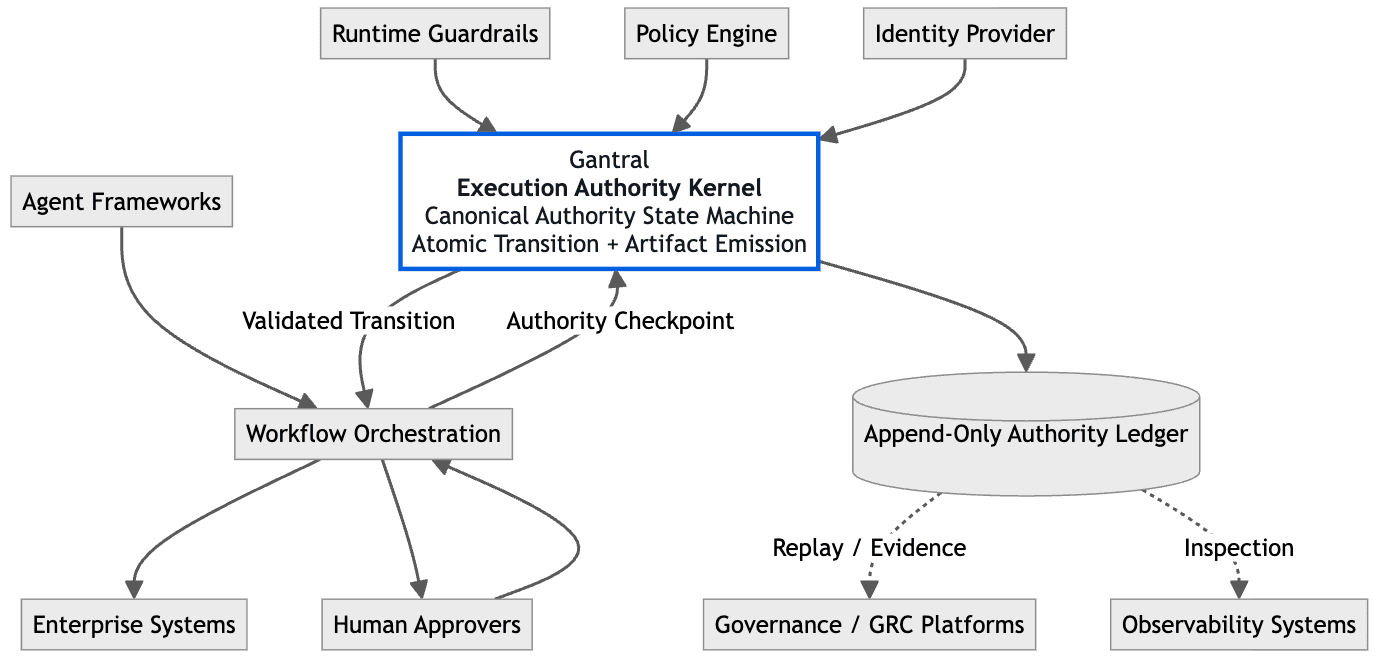
It does not observe.
It does not report.
It enforces.
Gantral Is Relevant If You Are
CIO / CTO
Scaling AI beyond pilots
Accountable for execution risk across business units
Concerned about structural governance gaps
Chief Risk Officer
Responsible for AI decision defensibility
Concerned about audit survivability
Chief Compliance Officer
Required to demonstrate enforceable human oversight
Seeking independence from runtime logs
Head of Platform Engineering
Managing multi-team agentic workflows
Facing policy drift and workflow duplication
Regulatory Alignment
Regulations require defensible oversight and traceable authority.
Structural authority binding strengthens that defensibility in high-materiality environments.
Framework
Requires
Without Gantral
With Gantral
EU AI Act
Enforceable human oversight
Approval embedded in workflow
Structural authority pause
NIST AI RMF
Governed execution
Logs reconstruct decisions
Independent replay validates
ISO 42001
Traceable decision control
Distributed approvals
Artifact chain evidence
Regulatory environments
Independent validation
Runtime-dependent explanation
Log-independent replay
Governance observes.
Authority enforces.
Integration Model
Gantral integrates at authority boundaries.
It integrates:
With orchestration platforms via authority checkpoints.
With policy engines in advisory mode.
With identity providers via federated authentication.
With GRC platforms via artifact export.
With cloud AI workflows via blocking execution steps.
Gantral does NOT replace:
Workflow orchestration
Runtime guardrails
Observability platforms
GRC systems
Agent frameworks
Orchestration coordinates tasks.
Gantral governs authority.
Open Infrastructure
Gantral’s execution core is open source (Apache 2.0).
This enables:
Independent inspection of execution semantics
Third-party security review
Long-term regulatory confidence
Vendor-neutral authority infrastructure
The formal specification and reference implementation are described formally in the Zenodo publication (v1.0).
Authority Must Be a Property of Execution
Gantral enables incremental, reversible introduction of deterministic authority without rewriting agents.
Infrastructure for agentic AI begins at the authority layer.
→ Engage as a Design Partner
→ Review Execution Semantics
→ Verifiability & Independent Replay